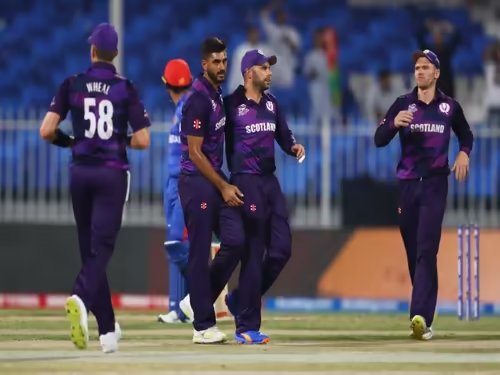
It started as a quiet disappointment—a missed opportunity for a team that had trained, dreamed, and prepared for years. But in the unpredictable world of international cricket, fate sometimes throws a curveball when you least expect it. For Scotland’s national cricket team, that moment came when Bangladesh officially pulled out of the 2026 ICC Men’s T20 World Cup due to unforeseen circumstances, opening the door for the Scots to step in at the last minute.
Now, instead of watching from home, Scotland is packing its bags for India—many for the first time—with a squad blending seasoned campaigners and exciting new talent like uncapped all-rounder Finlay McCreath. This isn’t just a participation trophy; it’s a hard-earned shot at glory on the global stage. And they’re not here to make up the numbers.
Table of Contents
- How Scotland Got a Second Chance
- T20 World Cup Squad: Experience Meets Youth
- Finlay McCreath’s Fairytale Call-Up
- The Road Ahead: Challenges and Opportunities
- Why This Matters for Associate Cricket
- Conclusion
- Sources
How Scotland Got a Second Chance
Originally, Scotland had failed to qualify directly for the main draw of the T20 World Cup through the regional qualifiers. Their hopes seemed dashed—until Bangladesh’s sudden withdrawal created an emergency vacancy. As the next highest-ranked non-qualified team in the ICC T20I rankings, Scotland was the logical replacement under ICC protocols [[1]].
This isn’t the first time luck has played a role in Scotland’s World Cup journey—they famously benefited from Zimbabwe’s withdrawal in 2015—but this feels different. The team is more mature, more experienced, and better prepared than ever before. According to captain Richie Berrington, “We’ve been training as if we were going anyway. When the call came, we were ready.”
T20 World Cup Squad: Experience Meets Youth
The revised 15-man squad reflects a careful balance between battle-tested veterans and hungry newcomers. Over half the squad—including Berrington, George Munsey, and Mark Watt—were part of Scotland’s historic campaign in the 2021 T20 World Cup, where they famously defeated Bangladesh in a stunning upset [[3]].
This continuity provides crucial stability. These players know what it takes to compete against Full Members. They understand the pressure, the pace, and the precision required at this level. At the same time, fresh blood injects energy and unpredictability. The inclusion of young talents signals a transition phase—but one built on a solid foundation.
Finlay McCreath’s Fairytale Call-Up
Few stories capture the magic of sport like that of Finlay McCreath. A 24-year-old all-rounder from Edinburgh, McCreath was not even on the initial standby list. But with last-minute logistical and fitness considerations, selectors turned to him as a late addition—and his life changed overnight.
“I was at work when my phone blew up,” McCreath shared in a recent interview. “One minute I’m planning weekend nets, the next I’m booking a flight to India. It’s surreal.” Though uncapped at the senior international level, McCreath has impressed in domestic circuits with his aggressive left-handed batting and handy medium pace. His selection underscores Scotland’s willingness to back potential in high-stakes environments.
The Road Ahead: Challenges and Opportunities
Let’s be realistic: Scotland’s path in the T20 World Cup won’t be easy. Drawn into a group likely featuring powerhouses like India, Australia, or South Africa (final groups pending), they’ll face relentless pressure from ball one. Recent warm-up matches haven’t gone their way, with losses exposing vulnerabilities in death bowling and middle-order fragility [[2]].
Yet, history shows Scotland thrives as the underdog. Their game plan will likely revolve around:
- Explosive Powerplays: Leveraging openers like Munsey to take early wickets or post big totals.
- Spin Control: Using wrist-spinner Chris Greaves and left-arm orthodox Mark Watt to stifle opposition batters on subcontinental pitches.
- Mental Toughness: Drawing on past World Cup experience to stay composed in high-pressure chases or tight finishes.
Even if they don’t reach the Super 8s, a single marquee win—like their 2021 triumph over Bangladesh—could redefine their tournament.
Why This Matters for Associate Cricket
Scotland’s late inclusion is more than a feel-good story—it’s a vital moment for Associate nations worldwide. In an era where cricket’s global growth is often lip service, giving teams like Scotland a genuine platform demonstrates the ICC’s commitment to inclusivity [[4]].
Every match they play against a Full Member is a showcase for talent, resilience, and the sport’s expanding footprint. Broadcasters get fresh narratives. Fans discover new heroes. And young cricketers in Nairobi, Kuala Lumpur, or Bridgetown see proof that dreams aren’t limited to traditional cricketing nations. As [INTERNAL_LINK:associate-cricket-development] initiatives gain traction, moments like this become catalysts for long-term change.
Conclusion
Scotland’s journey to the T20 World Cup is a testament to perseverance, preparation, and a little bit of fortune. From the despair of near-miss qualification to the euphoria of a last-minute call-up, they’ve embraced their second chance with grit and grace. With a mix of old hands and new stars like Finlay McCreath, they arrive in India not just as participants, but as believers. Whether they pull off another giant-killing or simply leave everything on the field, their presence enriches the tournament—and reminds us why cricket’s global spirit matters.