Table of Contents
- The Jaws of Defeat: Pakistan’s Collapse
- Faheem Ashraf T20 World Cup Heroics
- The Penultimate Over That Changed Everything
- Why This Win Matters More Than It Seems
- Netherlands Deserved Better
- What Next for Pakistan in the Tournament?
- Conclusion: A Wake-Up Call Disguised as a Win
In a match that had all the makings of a historic upset, Pakistan stared down the barrel of a humiliating loss to the Netherlands in their 2026 T20 World Cup opener. Chasing a modest 153, they were left reeling at 119/7 with just 21 balls remaining. The Eden Gardens crowd was stunned into silence. Social media was already drafting obituaries for Pakistan’s campaign.
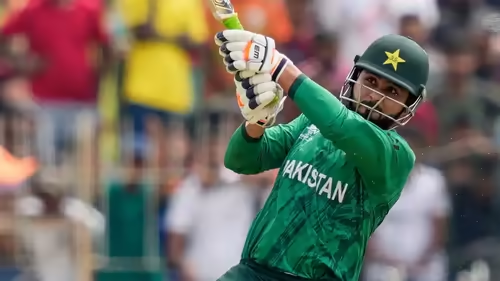
Then, out walked Faheem Ashraf—and in the space of 11 explosive deliveries, he authored one of the most thrilling escapes in T20 World Cup history. His unbeaten 29 not only snatched victory from the Dutch but also exposed deep cracks in Pakistan’s batting lineup that can’t be ignored [[1]].
The Jaws of Defeat: Pakistan’s Collapse
The chase started promisingly, with openers laying a solid foundation. But once the middle order—featuring stars like Babar Azam and Mohammad Rizwan—got bogged down, the innings stalled. They consumed 40+ balls for just 38 runs between overs 10 and 15, allowing the Netherlands’ bowlers to build relentless pressure [[1]].
Wickets fell in clusters. By the 17th over, Pakistan needed 34 off 21 balls with only three wickets in hand. The equation looked simple on paper, but with tailenders at the crease and the weight of a World Cup opener on their shoulders, it felt impossible. That’s when Faheem Ashraf walked in—and changed everything.
Faheem Ashraf T20 World Cup Heroics
Faheem didn’t just hit boundaries—he dismantled the Dutch attack with surgical precision. His 29* came off just 11 balls, featuring four sixes and one four, at a staggering strike rate of 263.63 [[1]]. But what made his knock truly special wasn’t just the power—it was the composure under extreme duress.
He targeted specific bowlers, identified weak lengths, and executed high-risk shots with flawless timing. In a format where panic often leads to rash strokes, Faheem remained ice-cool—a trait rarely associated with lower-order batters in such situations.
The Penultimate Over That Changed Everything
The turning point came in the 19th over, bowled by Bas de Leede. With 22 needed off 12 balls, the pressure was immense. Faheem responded with a masterclass in death-over hitting:
- Ball 1: SIX over long-on.
- Ball 2: Dot ball (defended).
- Ball 3: SIX over deep midwicket.
- Ball 4: SIX over long-off.
- Ball 5: Single to retain strike.
- Ball 6: Dot ball (defended by No. 11).
That over yielded 19 runs—effectively sealing the match. Pakistan needed just 3 off the final over, which they knocked off with three balls to spare. The transformation from near-certain defeat to jubilant victory happened in less than five minutes.
Why This Win Matters More Than It Seems
On the surface, it’s just two points in the group stage. But psychologically, this win is crucial for Pakistan for several reasons:
- Avoiding Early Elimination Pressure: A loss to the Netherlands would have put them in immediate danger of missing the Super 8s, especially with tougher games against India and South Africa ahead.
- Moral Boost for the Squad: After a turbulent lead-up to the tournament, this escape act provides a much-needed confidence injection.
- Highlighting Faheem’s Value: He’s often seen as just a bowling all-rounder, but this innings proves he can be a genuine finisher—a role Pakistan has lacked since Shahid Afridi’s retirement.
For more on Pakistan’s squad dynamics, see our analysis on [INTERNAL_LINK:pakistan-t20-world-cup-2026-squad-breakdown].
Netherlands Deserved Better
Let’s not forget the Dutch side, who played with heart, discipline, and tactical nous. Their bowlers—especially Logan van Beek and Tim Pringle—executed their plans brilliantly, restricting Pakistan’s star-studded top order to a crawl [[1]].
They created seven clear chances and converted six of them. On another day, with slightly better fortune or a less explosive opponent, they could have pulled off one of the biggest upsets in World Cup history. Their performance was a reminder that the gap between “minnows” and “giants” in T20 cricket is narrowing fast.
What Next for Pakistan in the Tournament?
This win papered over serious issues. Pakistan cannot rely on last-over miracles against stronger teams. Key concerns include:
- Middle-Order Stagnation: The lack of acceleration between overs 10–15 is a recurring problem.
- Over-Reliance on Individuals: One heroic knock shouldn’t mask systemic batting frailties.
- Death Bowling Vulnerability: While not tested here, their pace attack remains a question mark.
Up next is a blockbuster clash with India. If they bring the same passive approach, Faheem Ashraf’s heroics won’t be enough to save them.
Conclusion: A Wake-Up Call Disguised as a Win
Faheem Ashraf’s 11-ball blitz will be replayed for years as a classic T20 World Cup moment. But for Pakistan’s management, it should serve as a stark warning: talent alone isn’t enough. Structure, intent, and adaptability win tournaments—not last-minute miracles. The Faheem Ashraf T20 World Cup rescue was thrilling, but it must be the catalyst for urgent change, not a reason for complacency.
Sources
- Times of India: T20 WC: Ashraf scripts thrilling Pakistan escape vs Netherlands [[1]]
- ICC Match Centre: NED vs PAK – Full Scorecard & Highlights
- ESPNcricinfo: Pakistan’s Narrow Escape: Tactical Breakdown
- Cricbuzz: Faheem Ashraf Player Profile
- Wisden: Greatest T20 World Cup Finishes of All Time