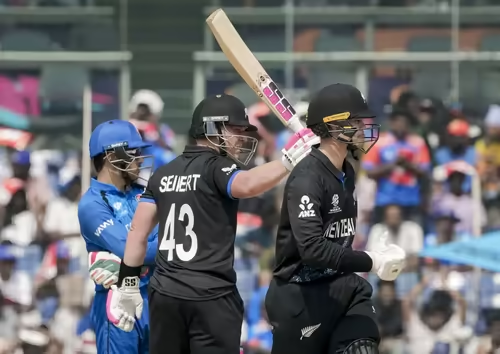
They came into the tournament as quiet contenders, not the flashy favorites. But on a warm evening in Chennai, the New Zealand Black Caps sent a thunderous message to the rest of the T20 World Cup field: they are here for the long haul, and they will not be intimidated.
Facing a spirited Afghanistan side that posted a formidable 182/6, powered by Gulbadin Naib’s gritty 63, many expected a tough ask for the Kiwis. Yet, in a performance that blended nerveless aggression with ice-cool temperament, New Zealand chased down the target with five wickets and two balls to spare. It was their highest successful run chase in T20 World Cup history—a feat that speaks volumes about their current form and mental fortitude [[1]].
This wasn’t just a win; it was a statement. In a tournament where the mantra is that there are no minnows in T20 cricket, even the so-called giants like New Zealand must earn every single point. And against a dangerous Afghan team, they did exactly that, proving why they remain one of the most respected units in world cricket.
Table of Contents
- The Chennai Thriller: A Chase for the Ages
- Tim Seifert’s Redemption and Glenn Phillips’ Fire
- Afghanistan’s Fighting Spirit and Missed Opportunities
- Why This Win Signals New Zealand’s Title Credentials
- Living the Reality: No Minnows in T20 Cricket
- Conclusion: The Black Caps Are Back
- Sources
The Chennai Thriller: A Chase for the Ages
The M.A. Chidambaram Stadium in Chennai is known for its slow, turning tracks that favor spinners. Afghanistan, with their world-class spin attack led by Rashid Khan and Mujeeb Ur Rahman, looked perfectly suited to exploit these conditions. Their total of 182/6 was built on a solid foundation from Naib and timely cameos from the lower order.
Chasing such a total on that surface was always going to be a monumental task. The pressure was immense, especially after losing early wickets. But New Zealand’s middle order, often their backbone, stood tall when it mattered most. They didn’t just chase the runs; they managed the chase with a masterclass in risk assessment and partnership building.
Tim Seifert’s Redemption and Glenn Phillips’ Fire
The architect of this historic chase was wicketkeeper-batter Tim Seifert. Returning to the international fold with a point to prove, Seifert played the innings of his life. His unbeaten 65 was a perfect blend of calculated aggression and intelligent shot selection. He targeted the spinners, used his feet brilliantly, and kept the scoreboard ticking even during the middle-overs slowdown [[5]].
He was ably supported by the explosive Glenn Phillips, whose quickfire 42 provided the initial momentum and shifted the pressure back onto the Afghan bowlers. Phillips’ ability to clear the boundary at will, even on a sluggish pitch, was crucial in keeping New Zealand ahead of the required rate. Together, they formed a partnership that was both resilient and ruthless.
Afghanistan’s Fighting Spirit and Missed Opportunities
Afghanistan, to their credit, did not go down without a fight. Gulbadin Naib’s captain’s knock of 63 was a masterclass in anchoring an innings under pressure. The spin trio of Rashid, Mujeeb, and Nabi created constant pressure, and they were just one or two key wickets away from pulling off a famous victory.
However, a few missed chances in the field and an inability to break the crucial Seifert-Phillips stand proved costly. Their performance, though ending in defeat, was a powerful reminder of their status as a top-tier T20 side—another nail in the coffin of the outdated ‘minnow’ label.
Why This Win Signals New Zealand’s Title Credentials
New Zealand has a reputation for being perennial bridesmaids in ICC events, having lost finals in both ODI and T20 World Cups. But this victory in Chennai feels different. It showcased a new level of maturity and chasing prowess that has sometimes been missing from their game.
Successfully chasing their highest-ever World Cup total, on a difficult pitch, against a high-quality opponent, demonstrates a champion’s mentality. It shows they can handle pressure, adapt to conditions, and execute a plan under the brightest lights. For a deeper analysis of their squad, check out our [INTERNAL_LINK:new-zealand-t20-world-cup-2026-squad-analysis].
Living the Reality: No Minnows in T20 Cricket
The phrase no minnows in T20 cricket is often used to describe the rise of Associate nations. But this match flipped the script. Here, it was the established giant, New Zealand, who had to prove they belonged against a team that has consistently punched above its weight.
Afghanistan’s total was that of a top-four side, not a pushover. New Zealand’s response was that of a team that understands the new world order: there are no easy games. Every opponent is capable of setting a challenging total, and every chase requires your absolute best. This mutual respect and high level of competition between all teams is what makes the current T20 World Cup so compelling.
Conclusion: The Black Caps Are Back
New Zealand’s thrilling victory over Afghanistan is more than just two points in the standings. It’s a declaration of intent. They have shown they possess the batting depth, the mental strength, and the tactical nous to go all the way in this tournament.
In a T20 World Cup defined by its unpredictability and the belief that there are truly no minnows in T20 cricket, the Black Caps have proven they are not just participants, but serious title contenders ready to fight for every ball until the very end.
Sources
- Times of India: T20 World Cup: New Zealand show they are ready for long haul
- ICC: Official Match Centre – New Zealand vs Afghanistan, T20 World Cup 2026
- ESPNCricinfo: New Zealand vs Afghanistan, T20 World Cup 2026 – Match Report
- Cricbuzz: Tim Seifert Player Profile
- BBC Sport: New Zealand survive Afghan scare in T20 World Cup thriller