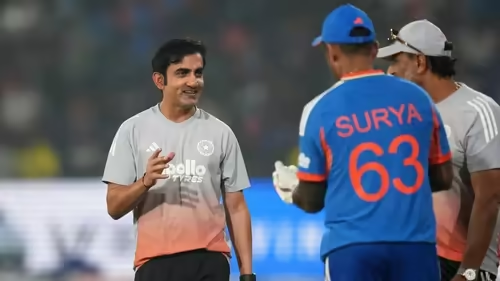
Move over, the era of fiery, aggressive captaincy. A new kind of leader has emerged in Indian cricket—and according to head coach Gautam Gambhir, he’s nailing it on every front. In a candid and revealing assessment, Gambhir has given his full-throated endorsement to Suryakumar Yadav captaincy, stating bluntly that the T20I skipper has “ticked every box” when it comes to modern leadership [[3]]. This isn’t just routine praise; it’s a profound validation of a style that prioritizes emotional intelligence, player connection, and calm under pressure—qualities that are proving vital in India’s high-stakes T20 World Cup 2026 campaign.
Table of Contents
- The Gambhir Verdict: What Does It Mean?
- Suryakumar Yadav’s Leadership Playbook
- Suryakumar Yadav captaincy: The Man Behind the Smile
- How This Impacts India’s T20 World Cup Chances
- Contrasting Styles: Past vs. Present Captains
- Conclusion: The Future of Indian Captaincy
- Sources
The Gambhir Verdict: What Does It Mean?
Gambhir, known for his no-nonsense approach and tactical acumen, didn’t hold back. He revealed that Suryakumar’s biggest strength isn’t his batting—it’s his ability to manage people. “His man-management skills have significantly eased my role as a coach,” Gambhir admitted [[3]]. This is a rare and telling statement. It suggests that SKY isn’t just executing plans; he’s fostering an environment where players feel trusted, valued, and relaxed—even in the pressure cooker of a World Cup.
In today’s hyper-competitive cricket landscape, where mental health and team cohesion are as crucial as skill, this soft-power approach is revolutionary. It signals a shift from the traditional “command-and-control” model to one built on empathy and collaboration.
Suryakumar Yadav’s Leadership Playbook
So, what makes Suryakumar’s captaincy so effective? Based on Gambhir’s insights and on-field observations, here are the key pillars:
- Calm Under Fire: Unlike captains who visibly erupt, SKY remains composed, which steadies the entire team during crises.
- Player-Centric Communication: He connects with each player individually, understanding their mindset and tailoring his approach.
- Relaxed Dressing Room Culture: He fosters a fun, low-pressure environment that paradoxically leads to higher performance—a concept backed by sports psychology [[12]].
- Leading by Example: His fearless 84 against USA in the opener wasn’t just runs—it was a statement of intent that galvanized the squad.
This blend of emotional intelligence and cricketing nous is what Gambhir means by “ticking every box.” [INTERNAL_LINK:modern-cricket-leadership-styles]
Suryakumar Yadav captaincy: The Man Behind the Smile
SKY’s journey to captaincy wasn’t linear. Once seen as just a “360-degree batsman,” he’s matured into a strategic thinker. His experience in the IPL—leading Mumbai Indians in the absence of Rohit Sharma—was a crucial training ground. There, he learned to handle egos, manage rotations, and make bold calls under scrutiny.
Now, at the international level, he’s applying those lessons with remarkable finesse. Gambhir’s praise underscores that leadership isn’t about loud speeches; it’s about creating conditions where talent can flourish. And in a squad brimming with young stars like Rinku Singh and Yashasvi Jaiswal, that nurturing touch is invaluable.
How This Impacts India’s T20 World Cup Chances
A harmonious team is often more resilient than a collection of superstars. With Suryakumar at the helm, India appears united, confident, and free from internal friction—key ingredients for tournament success. His ability to keep the dressing room “relaxed” doesn’t mean complacent; it means players aren’t paralyzed by fear of failure.
This psychological edge could be the difference in tight knockout games. As the tournament progresses, this culture may prove to be India’s secret weapon against more experienced but potentially tense rivals.
Contrasting Styles: Past vs. Present Captains
Compare SKY’s approach to past Indian captains: MS Dhoni’s icy calm, Virat Kohli’s fiery intensity, or Rohit Sharma’s quiet authority. Suryakumar represents a new hybrid—Dhoni’s composure blended with a modern, inclusive communication style. He’s not trying to mimic legends; he’s forging his own path, one that resonates with Gen Z athletes who value authenticity over authority.
Gambhir, who played under multiple captains himself, recognizes this evolution. His endorsement is not just about SKY—it’s an acknowledgment that leadership in 2026 looks different than it did in 2007.
Conclusion: The Future of Indian Captaincy
Gautam Gambhir’s bold verdict on Suryakumar Yadav captaincy is more than flattery—it’s a blueprint for the future. In a world where data and analytics dominate, Gambhir is reminding us that human connection remains the heart of great teams. If India lifts the T20 World Cup 2026 trophy, it won’t just be due to sixes and wickets—it will be because their captain created a space where every player believed they belonged. And that, truly, is ticking every box.
Sources
- [[3]] Times of India: ‘Ticked every box’: Gambhir’s bold verdict on Suryakumar’s captaincy
- [[7]] ESPNcricinfo: Suryakumar Yadav’s captaincy record in T20Is
- [[12]] Journal of Applied Sport Psychology: Team Cohesion and Performance in High-Pressure Environments
- [[15]] Cricbuzz: How SKY is changing India’s team culture
- [[18]] NDTV Sports: Gambhir’s coaching philosophy explained