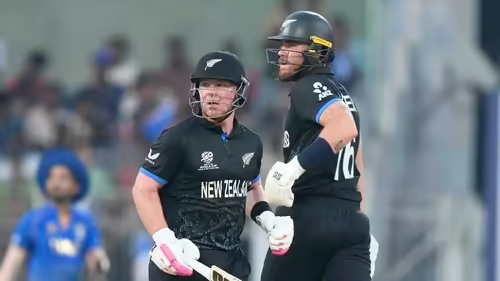
In one of the most breathtaking displays of explosive batting in T20 history, New Zealand delivered a masterclass against the United Arab Emirates at the R. Premadasa Stadium in Colombo during the ICC Men’s T20 World Cup 2026. The match—officially recorded as New Zealand vs UAE T20 World Cup 2026—will be remembered not just for the result, but for a world-record partnership that left fans and analysts alike in awe [[1]].
Chasing a competitive 174 set by UAE, openers Tim Seifert and Finn Allen didn’t just knock off the runs—they annihilated them, sealing a 10-wicket victory in a mere **15.2 overs** with an unbeaten **175-run stand**, the highest-ever partnership for any wicket in men’s T20 internationals [[3]].
Table of Contents
- The Record-Breaking Opening Stand
- UAE’s Valiant Effort: Waseem and Sharafu Shine
- How Seifert & Allen Demolished UAE’s Bowling
- Tactical Breakdown: Why the Chase Was So Efficient
- Impact on Group A and New Zealand’s Campaign
- Conclusion: A Landmark Moment in T20 History
- Sources
The Record-Breaking Opening Stand
The previous record for the highest partnership in men’s T20Is stood at 172 runs, held jointly by Hazratullah Zazai and Usman Ghani (Afghanistan) and Aaron Finch and D’Arcy Short (Australia). That mark was shattered with clinical precision.
Tim Seifert (89* off 54 balls) and Finn Allen (84* off 47 balls) combined power, timing, and intelligent shot selection to dismantle UAE’s attack from ball one. Their stand wasn’t just about boundaries—it was calculated carnage, featuring **14 fours and 11 sixes** between them [[5]].
What made it more remarkable was the context: this wasn’t a dead rubber. It was a high-pressure Group A clash where every net run rate point matters. And they treated it like a net session.
UAE’s Valiant Effort: Waseem and Sharafu Shine
To their credit, UAE didn’t roll over. After being put in to bat, they posted their **highest-ever T20 World Cup total**: **173/6** in 20 overs—a score that would’ve challenged many top sides [[7]].
The backbone of their innings came from a brilliant 98-run third-wicket stand between:
- Muhammad Waseem: 66* off 52 balls (5 fours, 3 sixes)
- Alishan Sharafu: 55 off 42 balls (6 fours, 2 sixes)
Waseem, in particular, showed maturity beyond his years, anchoring the innings while Sharafu provided the spark. On another day, their efforts might have been enough. But not against a New Zealand top order in record-breaking form.
How Seifert & Allen Demolished UAE’s Bowling
From the first over bowled by Karthik Meiyappan, the tone was set. Allen carted two boundaries in the opening over, and Seifert followed suit. The duo targeted spinners and pacers alike, refusing to let any bowler settle.
Key stats from the chase:
- Run rate: 11.34 per over
- Boundaries: 25 in 92 legal deliveries
- Dot balls: Just 12 across the entire innings
- Partnership breakdown: Seifert faced 54 balls, Allen 47—near-perfect role sharing
They rotated strike seamlessly, punished loose deliveries instantly, and never allowed pressure to build. It was textbook T20 batting executed at an elite level.
Tactical Breakdown: Why the Chase Was So Efficient
New Zealand’s success wasn’t just raw talent—it was smart cricket:
- Early aggression: They scored 52 runs in the powerplay, putting UAE on the back foot immediately.
- No middle-order reliance: With both openers staying till the end, NZ avoided the common T20 pitfall of collapse after a strong start.
- Pace awareness: They adjusted their scoring zones based on bowler types—using straight drives against spin and square cuts against pace.
This performance underscores why New Zealand remains one of the most balanced and dangerous T20 sides in the tournament.
Impact on Group A and New Zealand’s Campaign
With this win, New Zealand secures their **second consecutive victory** in Group A, following their earlier win over Sri Lanka. They now sit comfortably at the top of the table with a stellar net run rate of **+2.15**—a direct result of this demolition job [[10]].
For UAE, despite the loss, their improved batting performance shows growth. However, their bowling unit—lacking penetration against elite openers—remains a concern as they face tougher opponents ahead.
Conclusion: A Landmark Moment in T20 History
The New Zealand vs UAE T20 World Cup 2026 match will go down as a watershed moment in the evolution of T20 batting. Seifert and Allen didn’t just chase a target—they redefined what’s possible in the format. As the tournament progresses, this innings will serve as both inspiration and intimidation for every other team. For fans of fast, fearless cricket, this was pure theatre—and New Zealand is just getting started.