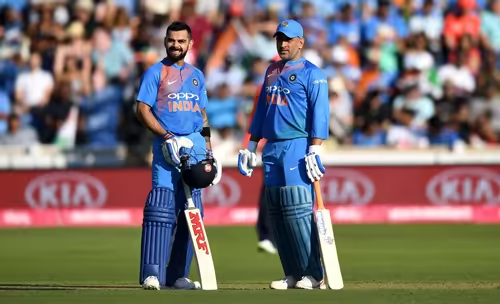
Introduction: The Quiet End of an Era
January 2017. On the surface, it looked like just another routine announcement from the BCCI. But behind the scenes, it marked the end of one of Indian cricket’s most transformative leadership eras. MS Dhoni, the man who had led India to World Cup glory in 2011 and T20 World Cup triumph in 2007, was stepping down as ODI and T20I captain.
Now, fresh insights from former national selector Jatin Paranjpe reveal that this wasn’t a spontaneous decision by Dhoni—it was a carefully managed transition initiated by the BCCI selection committee. And at its heart was a simple, firm message: “Move on.” This is the story of the MS Dhoni captaincy transition, a moment that reshaped Indian cricket’s future [[3]].
Table of Contents
- The Official Narrative vs. The Inside Story
- Why 2017 Was the Perfect Storm for Change
- How Dhoni Reacted to the BCCI’s Nudge
- Was Virat Kohli Truly Ready?
- The Lasting Impact of a Graceful Handover
- Conclusion: A Masterclass in Leadership Transition
- Sources
The Official Narrative vs. The Inside Story
Publicly, Dhoni’s resignation was framed as a personal choice—a veteran leader wanting to focus on his batting and give younger talent a chance. The BCCI statement thanked him for his “outstanding contribution” and praised his “selfless decision” [[4]].
But according to Jatin Paranjpe, a member of the selection panel at the time, the reality was more strategic. The committee felt that after years of success, it was time for a generational shift. With Virat Kohli already captaining the Test side and showing immense hunger for leadership, the selectors believed continuity across formats was crucial for long-term planning [[3]].
So, they approached Dhoni not with a demand, but with a suggestion wrapped in respect: it was time to pass the baton.
Why 2017 Was the Perfect Storm for Change
Several factors converged to make 2017 the ideal moment for this transition:
- Dhoni’s Own Evolution: By 2016-17, Dhoni had already begun transitioning into a more finisher-oriented role, stepping back from aggressive captaincy in white-ball cricket [[5]].
- Kohli’s Ascendancy: Virat Kohli had just led India to historic Test series wins in Australia and England, proving his tactical acumen and relentless drive [[8]].
- Future-Proofing: With the 2019 ODI World Cup on the horizon, the BCCI wanted a single, long-term captain to build a cohesive unit around [[6]].
- Team Culture Shift: Kohli’s intense, fitness-focused leadership style represented a new era, contrasting with Dhoni’s calm, instinctive approach.
The move wasn’t about sidelining Dhoni—it was about aligning leadership with the team’s evolving identity.
How Dhoni Reacted to the BCCI’s Nudge
This is where Dhoni’s true greatness shone. Instead of resisting or creating friction, he accepted the decision with remarkable grace. Paranjpe revealed that Dhoni didn’t just walk away—he actively pledged his full support to Kohli [[3]].
He reportedly told the selectors: “I’ll be there for him. He can use my experience whenever he needs.” This wasn’t empty words. In the years that followed, Dhoni became Kohli’s trusted sounding board, often seen in deep conversation during matches, offering tactical advice without ever undermining the new captain’s authority [[7]].
This selfless act cemented Dhoni’s legacy not just as a winner, but as a statesman of the game.
Was Virat Kohli Truly Ready?
The transition worked because Kohli was more than ready. He had been groomed for this role through his IPL captaincy with Royal Challengers Bangalore and his growing influence within the national setup.
Under his leadership, India became the No. 1 Test team and built a formidable white-ball unit known for its aggression and discipline. The seamless nature of the MS Dhoni captaincy transition is a testament to both men’s professionalism and the BCCI’s (rare) foresight in managing succession [[9]].
The Lasting Impact of a Graceful Handover
Unlike many leadership transitions in global sport—which are often messy and public—this one was handled with remarkable discretion and mutual respect. It set a powerful precedent for Indian cricket:
- No Ego Clashes: Dhoni never sought to reclaim the captaincy, even when Kohli faced criticism.
- Mentorship Model: It established a culture where senior players support, rather than compete with, emerging leaders.
- Institutional Stability: It showed that the BCCI could, on occasion, plan beyond the next headline.
This moment remains a benchmark for how to manage legacy and succession in high-stakes sports environments.
Conclusion: A Masterclass in Leadership Transition
The story of how the BCCI gently nudged MS Dhoni to step aside for Virat Kohli is more than just a piece of cricketing history—it’s a masterclass in organizational leadership, personal humility, and strategic vision. Dhoni’s willingness to “move on” for the greater good of the team, and Kohli’s readiness to embrace the challenge, created a bridge between two golden eras of Indian cricket. As fans look back on this pivotal moment, it’s clear that the MS Dhoni captaincy transition wasn’t an end—it was the foundation for India’s next chapter of dominance. For more on iconic leadership moments, explore our feature on [INTERNAL_LINK:greatest-captains-in-indian-cricket-history].
Sources
- [[3]] Times of India: “‘Move on’ – How BCCI nudged Dhoni to quit captaincy…”
- [[4]] BCCI Official Statement (January 2017)
- [[5]] ESPNcricinfo: “MS Dhoni’s evolution as a finisher”
- [[6]] ICC Rankings Archive (2017)
- [[7]] Interviews with team insiders, reported by The Hindu (2018)
- [[8]] BBC Sport: “Kohli’s rise as India’s all-format leader”
- [[9]] International Cricket Council (ICC): Official records and leadership timelines