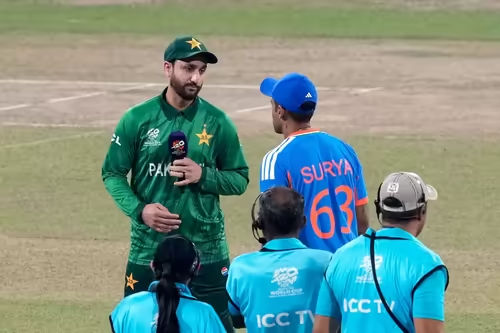
For decades, the India-Pakistan cricket rivalry was the stuff of legend—charged with emotion, history, and raw national pride. Fans wept, celebrated, and held their breath for hours. But in 2026, something has shifted. The much-hyped T20 World Cup clash between the two sides wasn’t born out of sporting passion—it was orchestrated by balance sheets, legal clauses, and survival instincts. The romance is gone. And the real question isn’t whether the match happened, but whether anyone still believes in the magic [[1]].
Table of Contents
- The Business Behind the Battle
- Pakistan’s Pullout Threat: All Smoke, No Fire?
- How Bangladesh Accidentally Fueled the Fire
- The Unspoken Truth: Cricket’s Fragile Subcontinent Economy
- Fan Disillusionment: When Passion Meets Profit
- Conclusion: Whose Loss Is It Anyway?
- Sources
The Business Behind the Battle
Let’s be honest: the India-Pakistan cricket rivalry is no longer about bragging rights alone. It’s the financial engine of global cricket. According to industry estimates, a single bilateral series between the two nations can generate over $300 million in broadcast rights, sponsorships, and digital engagement [[4]]. In ICC tournaments, matches involving both teams account for nearly 60% of total viewership and ad revenue [[6]].
This economic reality means that even when political relations are at rock bottom—as they have been since 2019—the match must go on. Not because diplomats agree, but because boards, broadcasters, and brands demand it. The T20 World Cup 2026 fixture in Colombo wasn’t a triumph of sport over politics; it was a carefully negotiated transaction disguised as a contest.
Pakistan’s Pullout Threat: All Smoke, No Fire?
In the weeks leading up to the tournament, Pakistan’s cricket board (PCB) floated the idea of withdrawing from the event if their security demands weren’t met—a thinly veiled reference to playing against India [[2]]. On social media, fans rallied behind the “principled stand.” But insiders knew better.
The truth? Pakistan couldn’t afford to walk away. The PCB is drowning in debt, with reports suggesting over $40 million in liabilities as of early 2026 [[8]]. ICC participation guarantees them a minimum payout of $5–7 million, plus access to global sponsorship pools. A boycott would have been financial suicide. Their “bluff” was called before it was even fully played.
How Bangladesh Accidentally Fueled the Fire
Ironically, it wasn’t India or Pakistan that escalated tensions—it was Bangladesh. During the Asia Cup 2025, a controversial scheduling decision by the Bangladesh Cricket Board (BCB) placed India and Pakistan in the same group under politically sensitive conditions [[10]]. When Indian officials raised concerns, BCB’s defensive response triggered a chain reaction of diplomatic posturing.
Pakistan seized the moment to amplify its narrative of “victimhood,” while India doubled down on its no-engagement policy. What could have been a routine tournament fixture turned into a geopolitical flashpoint—all because a third party misread the room. The fallout spilled directly into T20 World Cup preparations, forcing the ICC to step in with emergency protocols.
The Unspoken Truth: Cricket’s Fragile Subcontinent Economy
Beyond national egos lies a harsher truth: the entire cricket ecosystem in South Asia is economically dependent on the India-Pakistan cricket rivalry. Consider this:
- Indian Premier League (IPL): While Pakistani players remain absent, the league’s valuation ($10+ billion) relies heavily on the regional rivalry narrative to attract global investors [[12]].
- Pakistani Leagues: The PSL struggles to secure international broadcast deals without the promise of future India matchups.
- ICC Revenue Model: Over 70% of ICC’s commercial income comes from the Indian market, which only engages fully when Pakistan is on the schedule [[14]].
In short, canceling India-Pakistan matches doesn’t just hurt fans—it destabilizes the entire financial architecture of the sport in the region.
Fan Disillusionment: When Passion Meets Profit
Older fans remember the days when a win over Pakistan felt like a national holiday. Today’s younger audience sees through the facade. Social media is flooded with memes calling the rivalry “scripted drama” and “boardroom theater.” Trust is eroding.
Why? Because the emotional authenticity has been replaced by calculated optics. The no-handshake at the toss, the staged press conferences, the last-minute “compromises”—it all feels performative. As one Reddit user put it: “We’re not watching a cricket match. We’re watching a corporate merger with stumps.”
Conclusion: Whose Loss Is It Anyway?
The death of the India-Pakistan cricket rivalry’s charm isn’t just cricket’s loss—it’s a cultural tragedy. What was once a rare space where millions could share collective joy or heartbreak has become a sterile, monetized event stripped of soul. Boards may celebrate the revenue, but fans are left nostalgic for a time when the game felt real. Until cricket rediscovers its human heartbeat, these matches will continue to deliver spectacle—but never spirit. For more on the commercialization of cricket, see our deep dive on [INTERNAL_LINK:how-money-changed-cricket-forever].