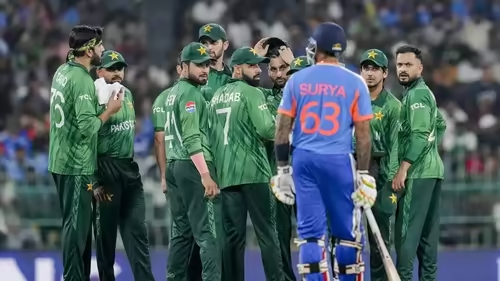
Everyone expected fireworks from batters in the India vs Pakistan T20 World Cup 2026 clash—but no one saw it coming from Saim Ayub. The 21-year-old Pakistani opener, known more for his elegant left-handed strokeplay, turned into an unlikely bowling hero with a sensational triple-wicket over that sent shockwaves through the R. Premadasa Stadium in Colombo. In a span of just 14 deliveries, Ayub dismantled India’s middle order, dismissing Ishan Kishan, Tilak Varma, and Hardik Pandya to finish with figures of 3/25 in 4 overs—a spell that didn’t just take wickets but rewrote the narrative of the entire match [[1]].
Table of Contents
- The Triple-Strike Moment: How It Unfolded
- Saim Ayub: From Opener to Match-Winning Bowler
- How Ayub’s Spell Derailed India’s Momentum
- Historical Context: Rare Feats by Part-Timers in India vs Pakistan
- Tactical Genius or Lucky Gamble?
- Conclusion: A Star Is Born in the Heat of Rivalry
- Sources
The Triple-Strike Moment: How It Unfolded
India was cruising at 98/2, with Ishan Kishan looking unstoppable on 62 off 35 balls. The momentum was firmly with the Men in Blue. Then, in the 12th over, Pakistan captain Salman Ali Agha made a bold call: he tossed the ball to Saim Ayub, who had bowled just two overs in his entire T20I career before this match.
What followed was pure theatre:
- Ball 3: Kishan, attempting a sweep, top-edged a flighted delivery straight to midwicket. Gone for 62.
- Ball 5 (next over): Tilak Varma, trying to rotate strike, played across the line and was trapped LBW by a sharp turner.
- Ball 2 (following over): Hardik Pandya shouldered arms to a quicker one—and watched in disbelief as it crashed into middle stump. Golden duck.
In just 14 balls, Ayub turned a promising Indian innings into a crisis, reducing them from 98/2 to 112/5 [[1]]. The stadium erupted; the Indian dugout fell silent.
Saim Ayub: From Opener to Match-Winning Bowler
Ayub isn’t a frontline bowler—he’s a top-order batter with a first-class batting average of 42. But in domestic cricket for Karachi Whites, he’s occasionally rolled his arm over as a left-arm orthodox spinner, picking up wickets in pressure situations [[3]]. Still, few expected him to be Pakistan’s X-factor against India.
His action is smooth, his flight deceptive, and his control under pressure remarkable for a player of his age. On a Colombo pitch offering subtle turn, Ayub’s variations—especially the arm ball disguised as a stock delivery—fooled even seasoned international batters. His economy rate of 6.25 further underscores his discipline.
How Ayub’s Spell Derailed India’s Momentum
Before Ayub’s intervention, India was on track for a 190+ total. After his triple strike, the innings never recovered. The psychological impact was profound:
- Loss of key players: Kishan was the anchor; Pandya the finisher; Varma the stabilizer. Losing all three in quick succession left India scrambling.
- Run-rate collapse: India scored just 77 runs in the final 10 overs after racing to 98 in the first 11.
- Pressure on lower order: Batters like Axar Patel and Washington Sundar were forced into roles they weren’t prepared for.
Ultimately, India posted 175/7—a competitive total, but 15–20 runs short of what seemed possible before Ayub’s heroics [[5]].
Historical Context: Rare Feats by Part-Timers in India vs Pakistan
While frontline bowlers dominate this rivalry, part-timers have occasionally stolen the show. Notable examples include:
- Shahid Afridi (2005): Took 2/15 with his leg-spin in a tense ODI in Lahore.
- Virat Kohli (2012): Clean bowled Umar Akmal in a T20I with his medium pace.
- Shoaib Malik (2007): Claimed 3/25 in a World T20 group match.
But Ayub’s triple strike in a World Cup match—against a full-strength Indian batting lineup—stands out as one of the most impactful part-time spells in the history of India vs Pakistan T20Is [[7]].
Tactical Genius or Lucky Gamble?
Captain Salman Ali Agha’s decision to bowl Ayub was either a masterstroke or a desperate roll of the dice. Analysts are split:
Supporters argue it showcased brilliant tactical flexibility—using an unorthodox option when frontline spinners were being targeted. Critics say it was a fluke that worked once but isn’t replicable. Regardless, the result speaks for itself: Ayub’s spell was the turning point of the match, proving that in high-stakes cricket, sometimes the boldest calls yield the biggest rewards.
Conclusion: A Star Is Born in the Heat of Rivalry
Saim Ayub’s triple strike wasn’t just about wickets—it was about seizing a moment in one of sport’s greatest rivalries. In a match defined by power-hitting and political tension, it was a young batter’s unexpected bowling cameo that stole the spotlight. As Pakistan celebrates this tactical triumph, India is left to ponder what might have been. One thing is certain: Saim Ayub has announced himself on the world stage in the most dramatic fashion possible. For more on emerging Pakistani talents, see our feature on [INTERNAL_LINK:pakistans-next-generation-cricketers].