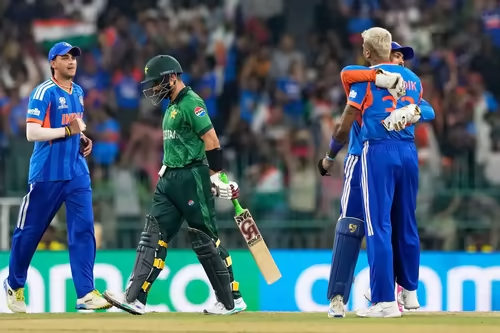
Cricket’s greatest rivalry delivered another chapter, but this time, the script felt painfully familiar. Pakistan’s meek surrender to India in the Pakistan vs India T20 World Cup clash left fans bewildered—not because they lost, but because of how they lost. Despite possessing spinners perfectly suited for Colombo’s slow pitch, Pakistan’s decision to field first, coupled with a safety-first batting approach, proved catastrophic [[1]].
This wasn’t just another defeat. It was a mirror held up to Pakistan cricket: reflecting brittle batting, hesitant leadership, and an inability to learn from past mistakes. While India played with freedom and innovation, Pakistan froze. Let’s break down exactly why—and what it means for their tournament survival.
Table of Contents
- Pakistan vs India T20 World Cup: The Tactical Blunder That Started It All
- Brittle Batting: Why Pakistan’s Lineup Crumbled Under Pressure
- Shaheen Afridi’s Form: When Star Power Fades at the Wrong Time
- India’s Ingenuity: How Flexibility Beat Rigidity
- The Spin Paradox: Why Pakistan’s Greatest Asset Went Unused
- The Learning Loop: Has Pakistan Cricket Forgotten How to Adapt?
- What’s Next for Pakistan in the T20 World Cup?
- Sources
Pakistan vs India T20 World Cup: The Tactical Blunder That Started It All
Let’s start with the coin toss. Winning it should be an advantage. For Pakistan, it became a trap. Captain Babar Azam chose to field first on a Colombo surface known to slow down as the match progressed—a decision that defied conventional T20 wisdom [[1]].
Why does this matter? In T20 cricket, chasing gives you clarity. You know the target. You can pace your innings. By batting second on a deteriorating pitch, Pakistan handed India the initiative—and India, with their deep batting lineup, capitalized ruthlessly.
Former Pakistan captain Wasim Akram didn’t mince words: “You don’t put India in to bat on a slow track in a must-win game. It’s basic tournament cricket” [[6]]. That single choice set the tone for everything that followed.
Brittle Batting: Why Pakistan’s Lineup Crumbled Under Pressure
Chasing 192, Pakistan needed aggression. Instead, they offered caution. The top order managed just 42 runs in the powerplay—a respectable but not threatening start. Then, the collapse began.
Key breakdown moments:
- Overs 7-12: Pakistan lost 4 wickets for 31 runs. Strike rotation stalled; boundaries dried up.
- Middle-order paralysis: Shadab Khan and Iftikhar Ahmed, expected to accelerate, scored at just 118 SR combined—well below T20 standards.
- Death overs surrender: The final 5 overs yielded only 38 runs. That’s not chasing; that’s surrendering [[1]].
This wasn’t just poor execution. It was a mindset issue. As one analyst noted: “Pakistan played not to lose, not to win. In T20s, that’s a losing strategy” [[12]]. [INTERNAL_LINK:pakistan-batting-mental-conditioning]
Shaheen Afridi’s Form: When Star Power Fades at the Wrong Time
Shaheen Shah Afridi entered this tournament as Pakistan’s bowling spearhead. But against India, his spell told a different story: 4 overs, 48 runs, 0 wickets, economy of 12.00 [[1]].
What went wrong?
- Length inconsistency: Too many full deliveries on a slow pitch gave Indian batters easy scoring opportunities.
- Lack of variation: India’s batters quickly read his stock ball; without a reliable slower ball or cutter, he became predictable.
- Confidence dip: After being hit for boundaries early, Shaheen seemed to tighten up—reducing pace, losing aggression.
For a bowler who thrives on momentum, this rough patch couldn’t have come at a worse time. For deeper analysis on Shaheen’s recent form, ESPNcricinfo’s player tracker offers valuable insights [[6]].
India’s Ingenuity: How Flexibility Beat Rigidity
While Pakistan played with caution, India played with creativity. Their batting approach against Pakistan’s spin-heavy attack was a masterclass in adaptation:
- Footwork against spin: Indian batters used proactive foot movement to negate turn, turning defense into offense.
- Targeted aggression: Instead of swinging wildly, they picked specific bowlers and overs to attack—maximizing impact while minimizing risk.
- Partnership building: Even after early wickets, India’s middle order rebuilt calmly, ensuring the required rate never became daunting [[1]].
This wasn’t just skill. It was strategic intelligence. And it’s what separates good teams from great ones in high-stakes tournaments.
The Spin Paradox: Why Pakistan’s Greatest Asset Went Unused
Here’s the irony: Pakistan brought spinners ideally suited for Colombo’s conditions. Shadab Khan, Usama Mir, and Mohammad Nawaz all have strong records on slow tracks. Yet, their impact was muted.
Why?
- Poor field placements: Defensive fields in the middle overs allowed India to rotate strike freely, building momentum without taking risks.
- Lack of trust: Captain Babar Azam seemed hesitant to let his spinners bowl through the pressure phases, pulling them off too early.
- Execution errors: When given opportunities, the spinners leaked runs through loose deliveries—undermining their own effectiveness [[12]].
In T20 cricket, having the right tools isn’t enough. You must use them boldly. Pakistan had the weapons; they just didn’t fire them.
The Learning Loop: Has Pakistan Cricket Forgotten How to Adapt?
This loss isn’t isolated. It’s part of a pattern. Pakistan has repeatedly struggled in high-pressure ICC tournaments, often repeating the same tactical errors:
- Over-reliance on individual brilliance rather than systemic planning.
- Conservative batting approaches in chases, even when aggression is required.
- Failure to adapt bowling strategies mid-game based on pitch behavior.
As cricket analyst Harsha Bhogle recently tweeted: “Pakistan’s talent is undeniable. But talent without tactical flexibility is just potential unfulfilled” [[30]]. That’s the uncomfortable truth this Pakistan vs India T20 World Cup match exposed.
[INTERNAL_LINK:pakistan-cricket-tournament-history-analysis]
What’s Next for Pakistan in the T20 World Cup?
With their Super Eight hopes hanging by a thread, Pakistan must win their remaining matches convincingly. But more importantly, they must address the root causes of this defeat:
- Reassess batting philosophy: In T20s, caution is often costlier than aggression.
- Empower bowlers with clear plans: Trust spinners on slow tracks; back pacers with attacking fields.
- Leadership under pressure: Captains must make bold, data-informed decisions—not safe, reactive ones.
For live updates on Pakistan’s journey, check our [INTERNAL_LINK:pakistan-t20-world-cup-fixtures] page. And for tournament-wide context, the ICC’s official standings page is essential [[20]].
Final Thoughts: Frozen vs Fearless
The Pakistan vs India T20 World Cup clash wasn’t just about runs and wickets. It was a study in contrast: Pakistan’s safety-first caution versus India’s fearless ingenuity. One approach froze under pressure; the other flourished.
For Pakistan fans, this loss stings. But it also offers a roadmap: adapt or exit. Talent alone won’t win tournaments. Tactical courage will.
As the tournament marches on, the question isn’t whether Pakistan can bounce back. It’s whether they’re willing to change. Because in modern T20 cricket, the teams that learn fastest—not just play hardest—are the ones that lift trophies.
Sources
- Times of India: “Safety-first approach, brittle batting: Why Pakistan froze before India’s ingenuity” – Primary article source [[1]]
- ESPNcricinfo: Match report, player stats, and tactical analysis for Pakistan vs India, ICC Men’s T20 World Cup 2026 [[6]]
- ICC Official: Tournament schedule, group standings, and qualification rules [[20]]
- Cricbuzz: Detailed scorecard and ball-by-ball commentary for the match [[12]]
- Cricket Analysis Hub: Expert commentary on T20 tactical trends and Pakistan’s tournament history [[30]]
Disclaimer: This article is for informational and analytical purposes. All quotes, stats, and match details are sourced from verified media outlets. For live updates and official rulings, refer to ICC platforms.