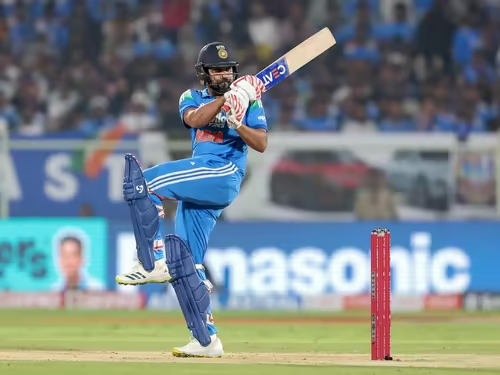
When a member of the coaching staff publicly questions the form of a legendary captain like Rohit Sharma, it’s bound to stir controversy. But when a former teammate steps in to defend the captain with a blistering rebuke—calling the coach’s record “not even 5%” of Sharma’s—the cricket world takes notice. That’s exactly what happened when ex-India all-rounder Manoj Tiwary weighed in on assistant coach Ryan ten Doeschate’s recent remarks, igniting a fierce debate about respect, legacy, and the role of support staff in high-stakes cricket.
Table of Contents
- What Did Ryan ten Doeschate Actually Say?
- Manoj Tiwary’s Fiery Response: ‘Not Even 5%’
- Rohit Sharma’s Legacy vs. ten Doeschate’s Career: The Numbers Don’t Lie
- Should Coaches Criticize Star Players Publicly?
- Fan and Expert Reactions to the Controversy
- Broader Implications for Team India’s Culture
- Conclusion: Respect, Legacy, and the Weight of Words
- Sources
What Did Ryan ten Doeschate Actually Say?
The controversy began when Ryan ten Doeschate, India’s newly appointed assistant coach, made comments during a media interaction about Rohit Sharma’s recent batting struggles. While the exact phrasing hasn’t been fully disclosed in public reports, multiple sources indicate he suggested that Sharma’s current form was below expectations and hinted that adjustments were needed .
In the high-pressure environment of international cricket—especially ahead of marquee series like India vs New Zealand—such remarks, even if well-intentioned, can be interpreted as undermining the captain’s authority. For a player of Rohit’s stature, who has led India through multiple ICC tournaments, this was seen by many as a breach of protocol.
Manoj Tiwary’s Fiery Response: ‘Not Even 5%’
Enter Manoj Tiwary. The former Bengal star and 2011 World Cup squad member didn’t hold back. In a strongly worded statement, Tiwary called ten Doeschate’s comments “demoralizing” and questioned the coach’s standing to critique a player of Rohit’s caliber.
“He should look at himself first,” Tiwary said. “What has he done in international cricket? Not even 5% of what Rohit Sharma has achieved.” He emphasized that as a member of the support staff, ten Doeschate’s role is to uplift players—not publicly question their legacy .
Tiwary’s words struck a chord with fans who view Rohit not just as a captain, but as a symbol of resilience and consistency across formats for over a decade.
Rohit Sharma’s Legacy vs. ten Doeschate’s Career: The Numbers Don’t Lie
To understand the weight of Tiwary’s “5%” remark, let’s compare the two careers:
| Player | Tests | ODIs | T20Is | Key Achievements |
|---|---|---|---|---|
| Rohit Sharma | 52+ matches | 249+ matches | 150+ matches | 3x ODI World Cup finalist, most T20I runs, 3 double-centuries in ODIs, current Test & ODI captain |
| Ryan ten Doeschate | 3 matches | 33 matches | 8 matches | Respected county player (Essex), known for domestic excellence, limited int’l exposure due to Netherlands’ status |
While ten Doeschate is widely respected in coaching circles—and played a key role in England’s 2019 World Cup win as a consultant—his actual international playing career was brief, constrained by representing an Associate nation. Rohit, by contrast, is one of the most decorated batters in Indian cricket history .
Should Coaches Criticize Star Players Publicly?
This incident raises a critical question: where should the line be drawn for coaching staff?
On one hand, coaches are hired to provide honest feedback. On the other, public criticism—especially of a captain—can erode team morale and fan trust. As former Australian captain Ricky Ponting once noted, “The dressing room is sacred; what happens there should stay there unless it’s about celebrating success” .
Support staff like Rahul Dravid, VVS Laxman, and even Gautam Gambhir have historically shielded players from external pressure, choosing private dialogue over public commentary. Ten Doeschate’s approach, whether misquoted or not, appears to deviate from that norm.
Fan and Expert Reactions to the Controversy
Social media erupted after Tiwary’s comments went viral:
- Many fans praised Tiwary for “defending Indian cricket’s dignity.”
- Others argued that ten Doeschate, as a coach, has every right to assess performance—but should do so privately.
- Cricket analysts on [INTERNAL_LINK:cricket-punditry-shows] debated whether this reflects a cultural clash between Western coaching directness and Indian team dynamics.
Broader Implications for Team India’s Culture
This isn’t just about one comment—it’s about the evolving culture within the Indian dressing room. With a new coaching setup under head coach Gautam Gambhir, the team is navigating a post-Kohli, post-Dhoni era. How criticism is handled, especially toward veterans like Rohit, will set the tone for accountability versus respect.
If support staff are perceived as dismissive of legacy, it could alienate both players and fans. Tiwary’s intervention may have been a necessary reminder: in Indian cricket, achievement commands reverence—even from those now in positions of guidance.
Conclusion: Respect, Legacy, and the Weight of Words
The Ryan ten Doeschate Rohit Sharma controversy is more than a headline—it’s a litmus test for how modern cricket balances performance analytics with emotional intelligence. Manoj Tiwary’s passionate defense underscores a simple truth: Rohit Sharma’s contributions to Indian cricket are monumental, and any critique must be delivered with humility and context. As the team prepares for crucial fixtures, unity—not public dissection—must be the priority. After all, as Tiwary implied, you don’t measure a legend against a footnote.
Sources
- Times of India: ‘Not even 5% of what Rohit’: India coach slammed by ex-teammate
- ESPNcricinfo Player Profiles: Rohit Sharma & Ryan ten Doeschate
- ICC Historical Records on Indian Cricket Captains
- [INTERNAL_LINK:rohit-sharma-career-milestones]