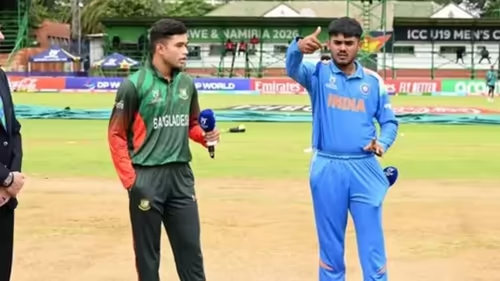
The simple act of a handshake is a cornerstone of cricket’s spirit—a silent pact of respect before the battle begins. So when India’s Ayush Mhatre and Bangladesh’s stand-in captain Zawad Abrar failed to exchange this customary gesture at the toss of their ICC U-19 World Cup 2026 clash in Zimbabwe, it sent shockwaves through the cricketing world . Was it a deliberate snub? A sign of deeper tensions? The ensuing speculation reached a fever pitch until the Bangladesh Cricket Board (BCB) finally broke its silence.
Table of Contents
- What Exactly Happened at the Toss?
- The BCB’s Official Statement: A ‘Momentary Lapse’
- Why Did This Cause Such a Fuss?
- A Brief History of Handshake Controversies in Cricket
- The Bigger Picture: The Spirit of Cricket Under Scrutiny
- Conclusion: A Lesson in Assumption vs. Reality
- Sources
What Exactly Happened at the Toss?
The incident occurred just before a crucial Group D match. With regular Bangladesh captain Azizul Hakim absent due to illness, vice-captain Zawad Abrar stepped in to lead the team for the toss . Footage from the ground showed the two young captains meeting at the center of the pitch, but after the coin was tossed and the decision made (Bangladesh elected to field first), they simply walked away in opposite directions without the traditional handshake . In the current climate of heightened political and sporting sensitivities between the nations, this small omission was instantly magnified into a major diplomatic incident on social media.
The BCB’s Official Statement: A ‘Momentary Lapse’
Facing intense scrutiny, the BCB moved swiftly to clarify the situation. In an official statement, the board explicitly stated that the U-19 World Cup handshake drama was not a calculated act of disrespect. “The BCB wishes to clarify that the absence of a handshake with the opposition captain was completely unintentional and resulted from a momentary lapse in concentration,” the statement read .
The board went on to emphasize its unwavering commitment to the spirit of the game and fair play, effectively shutting down theories of a pre-meditated boycott. This explanation, while simple, was a necessary step to de-escalate the situation and protect the reputation of its young players, who are still learning the nuances of international sport.
Why Did This Cause Such a Fuss?
To understand the outsized reaction, you have to look beyond the pitch. Recent years have seen a noticeable uptick in handshake refusals in high-stakes matches, particularly in fixtures involving India and its regional rivals.
- In the 2025 Asia Cup, senior Indian captain Suryakumar Yadav was seen refusing to greet his Pakistani counterpart .
- During the ICC Women’s World Cup in October 2025, the captains of the Indian and Pakistani women’s teams also skipped the handshake .
- Reports from the previous year’s tournaments indicated a pattern where Indian players refrained from shaking hands with Pakistani players throughout their matches .
This established context turned a potential innocent mistake into a suspected continuation of a worrying trend. Fans and pundits alike were quick to project these recent precedents onto the young U-19 players, assuming malice where there may have only been nerves or distraction.
A Brief History of Handshake Controversies in Cricket
While the current spate of incidents is concerning, handshake dramas are not new to cricket. The sport has a long, albeit sporadic, history of such moments:
- One of the earliest notable instances dates back to the 1996 World Cup final between Sri Lanka and Australia, where post-match handshakes were notably absent .
- More recently, in February 2023, a handshake boycott was reported during a Nepal vs. Oman series .
- Even within teams, there have been awkward moments, like when Virat Kohli appeared to ignore Sourav Ganguly during a presentation ceremony in April 2023 .
These events, though isolated, chip away at the game’s foundational value of mutual respect. They transform a friendly ritual into a loaded political or emotional statement.
The Bigger Picture: The Spirit of Cricket Under Scrutiny
The real tragedy of the U-19 World Cup handshake drama isn’t the missed gesture itself, but what it reveals about the state of the modern game. At the U-19 level, the primary goal is development—teaching young athletes not just how to play, but how to compete with integrity. When a simple oversight is interpreted as a hostile act, it shows how deeply the lines between sport and geopolitics have blurred.
The BCB’s swift clarification was a masterstroke in damage control, reaffirming their dedication to [INTERNAL_LINK:spirit-of-cricket] principles. It serves as a reminder that before jumping to conclusions, we should consider the human element—especially when the humans in question are teenagers under immense pressure on a global stage.
Conclusion: A Lesson in Assumption vs. Reality
In the end, the BCB’s statement appears to have put the controversy to rest. What was feared to be a deliberate act of hostility was, according to the official account, nothing more than a ‘momentary lapse in concentration’ . While the incident highlights the fragile nature of sportsmanship in today’s hyper-connected and often cynical world, it also offers a valuable lesson. Sometimes, the simplest explanation is the correct one. For the sake of the game’s future, especially for its young stars, let’s hope the spirit of the handshake can be restored to its rightful place—as a genuine symbol of respect, not a political pawn.
Sources
- Times of India: Handshake drama explained: BCB breaks silence on U-19 WC incident
- Various news reports on the BCB statement [[1], [2], [6], [7], [9], [12], [17]]
- Historical context on cricket handshake controversies [[10], [14], [18], [19], [22]]