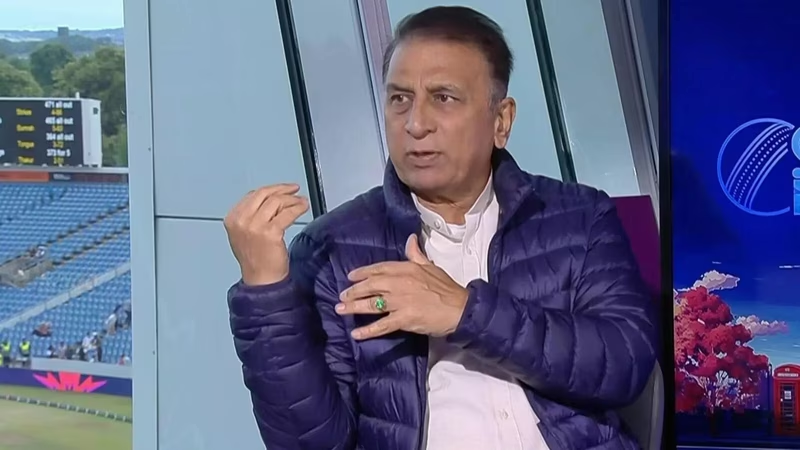
Sunil Gavaskar Takes on Social Media Giants—Delhi HC Orders Action in Landmark Digital Rights Case
In a bold move that could reshape how digital platforms handle celebrity content in India, cricket icon Sunil Gavaskar has taken legal action against the rampant misuse of his name, image, and likeness across social media. The Delhi High Court has now directed major platforms—including X (formerly Twitter), Facebook, and Instagram—to treat his grievance as a formal complaint and issue a resolution within **seven days**, invoking existing provisions under the Information Technology (Intermediary Guidelines) Rules, 2021 .
This isn’t just about one misleading post or fake endorsement. It’s a systemic challenge to the unchecked exploitation of public figures in the digital age—and it may set a crucial precedent for every celebrity, athlete, and public personality in India.
Table of Contents
- Why Sunil Gavaskar Took Legal Action
- Delhi HC Ruling: Key Directives
- The Legal Backbone: IT Rules and Publicity Rights
- A Growing Trend: Celebrities Fight Back
- What This Means for Social Media Platforms
- Broader Implications for Indian Public Figures
- Conclusion: A Turning Point for Digital Dignity
- Sources
Why Sunil Gavaskar Took Legal Action
For months, Gavaskar—widely regarded as one of cricket’s greatest opening batsmen—has been plagued by fabricated quotes, deepfake-style images, and AI-generated videos falsely claiming he endorsed dubious products, made political statements, or criticized current players .
These posts, often amplified by bots and fake accounts, don’t just mislead the public—they damage his reputation and commercial value. Despite repeated takedown requests, platforms were slow or inconsistent in acting, citing “user-generated content” policies.
Frustrated by the lack of accountability, Gavaskar’s legal team filed a petition in the Delhi High Court seeking urgent relief and a clear enforcement mechanism—a move that underscores how legacy figures are no longer passive victims of digital abuse.
Delhi HC Ruling: Key Directives
The court’s order is both swift and significant. Key directives include:
- Social media intermediaries must treat Gavaskar’s complaint as a **formal grievance** under Rule 3(2) of the IT Rules, 2021.
- Platforms must **resolve the issue within 7 days**—far faster than standard takedown timelines.
- They must provide **written confirmation** of actions taken to remove or disable access to infringing content.
- Failure to comply may result in the platform **losing its “safe harbor” immunity** under Section 79 of the IT Act .
This ruling effectively shifts the burden from the victim to the platform—forcing proactive moderation rather than reactive deletion.
The Legal Backbone: IT Rules and Publicity Rights
While India doesn’t have a standalone “right of publicity” law like the U.S., courts have increasingly recognized personality rights under Article 21 (Right to Privacy) of the Constitution and intellectual property statutes.
The 2021 IT Rules strengthened this by mandating grievance redressal mechanisms. Rule 3(1)(d) explicitly requires platforms to acknowledge complaints within 24 hours and resolve them within 15 days—but the Delhi HC has now **accelerated this to 7 days** in cases involving high-profile individuals, citing “reputational urgency.”
As noted by legal experts at the Ministry of Electronics and Information Technology (MeitY), this case could lead to clearer guidelines on handling impersonation and AI-generated misinformation .
A Growing Trend: Celebrities Fight Back
Gavaskar isn’t alone. A wave of Indian celebrities is pushing back:
- Amitabh Bachchan has repeatedly sued brands for unauthorized use of his image.
- Virat Kohli and Anushka Sharma have taken legal action against fake health product endorsements.
- Priyanka Chopra has confronted deepfake pornographic content online.
What makes Gavaskar’s case unique is its focus on **systemic platform accountability**—not just individual takedowns. It’s a strategic escalation that could benefit thousands of lesser-known public figures who lack his legal resources.
What This Means for Social Media Platforms
Platforms can no longer hide behind vague terms of service. The Delhi HC’s order signals that:
- “Celebrity” status triggers a **higher duty of care**.
- AI-generated or manipulated content using real identities may be treated as **defamatory by default
- Automated moderation tools must be enhanced to detect **impersonation at scale
.
.
For users, this could mean stricter verification for accounts posting about public figures—a trade-off between free expression and digital integrity.
Broader Implications for Indian Public Figures
This ruling empowers not just stars, but also journalists, academics, and athletes who face online harassment or impersonation. It validates that **digital dignity** is as real as physical reputation.
Our [INTERNAL_LINK:celebrity-digital-rights-guide] offers practical steps for public figures to protect their online identity—now more relevant than ever.
Conclusion: A Turning Point for Digital Dignity
Sunil Gavaskar’s legal stand is more than a personal victory—it’s a watershed moment for digital rights in India. By forcing platforms to act swiftly and responsibly, the Delhi High Court has drawn a clear line: your name, face, and legacy are not free content for the internet to exploit. As AI and deepfake technology evolve, this case may become the first chapter in a new era of online accountability—where respect isn’t optional, it’s enforceable.
Sources
Times of India: “Gavaskar moves Delhi HC against social media misuse; court orders platforms to act,” December 12, 2025. https://timesofindia.indiatimes.com/sports/cricket/news/sunil-gavaskar-moves-delhi-hc-against-social-media-misuse-court-orders-platforms-to-act-within-a-week/articleshow/125930549.cms
The Information Technology (Intermediary Guidelines and Digital Media Ethics Code) Rules, 2021, Ministry of Electronics and Information Technology, Government of India.
MeitY Public Consultation Paper on AI and Deepfakes, November 2025.
Supreme Court of India, Justice K.S. Puttaswamy vs. Union of India (2017) – Right to Privacy Judgment.