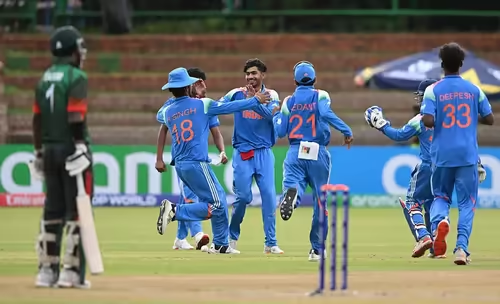
Cricket is a game of glorious uncertainties—but sometimes, it delivers moments so dramatic they feel scripted. In their Group D clash at the ICC U-19 World Cup 2026, India and Bangladesh served up exactly that: a match that swung violently from one side to the other, culminating in a stunning collapse that saw **8 wickets fall in just 8 overs**. At the heart of this turnaround? A 17-year-old spinner named Vihaan Malhotra, whose spell of 4 for 14 ripped the heart out of Bangladesh’s chase and handed India an 18-run victory via the DLS method .
Table of Contents
- Match Preview: High Stakes in Zimbabwe
- India’s Innings: Kundu and Sooryavanshi Anchor the Ship
- Bangladesh’s Strong Start – And Why It Felt Like Their Game
- The Collapse: 8 Wickets in 8 Overs That Changed Everything
- Vihaan Malhotra: The Quiet Assassin of the U-19 World Cup
- Understanding the DLS Method in This Rain-Hit Clash
- What This Win Means for India’s U-19 World Cup Campaign
- Conclusion: A Masterclass in Pressure Bowling
- Sources
Match Preview: High Stakes in Zimbabwe
Held at a rain-prone venue in Zimbabwe, this India vs Bangladesh U-19 World Cup encounter was always going to be tense. Both teams entered the match with one win each, making it a virtual knockout for semifinal hopes. With regional rivalry adding spice, expectations were sky-high—and the drama didn’t disappoint.
India’s Innings: Kundu and Sooryavanshi Anchor the Ship
Batting first, India struggled early against disciplined Bangladeshi seamers. Openers fell cheaply, leaving the top order reeling at 32/3. But then came a crucial 78-run stand between **Swaraj Kundu** and **Uday Saharan Sooryavanshi**, who showed maturity beyond their years.
Kundu scored a gritty 47 off 68 balls, while Sooryavanshi contributed a composed 39. Their partnership steadied the innings, allowing India to post a competitive 185/8 in their allotted 38.4 overs before rain interrupted play . Without their resilience, India’s total might have been far less defensible.
Bangladesh’s Strong Start – And Why It Felt Like Their Game
When rain subsided, Bangladesh’s revised DLS target was set at 157 in 25 overs—a very achievable chase. And they began like champions. Openers smashed boundaries with ease, racing to 50 without loss in under 6 overs. By the 12th over, they were 92/1, cruising at nearly 8 runs per over.
At that point, most fans—and likely the Indian dressing room—feared the worst. Bangladesh looked in complete control, and India’s bowlers appeared toothless. But as cricket often reminds us: never count your chickens before the spinners come on.
The Collapse: 8 Wickets in 8 Overs That Changed Everything
Enter Vihaan Malhotra. The left-arm orthodox spinner, brought on as a containment option, turned into India’s ultimate weapon. His first breakthrough came in the 13th over, trapping star batter Ariful Islam LBW with a sharp turner.
What followed was pure carnage:
- Over 14: Top-order batter caught at mid-wicket.
- Over 16: Captain Zawad Abrar stumped trying to reverse sweep.
- Over 18: Two wickets in four balls—both clean bowled.
- Over 20–21: Tailenders felled by run-outs and catches.
From 92/1, Bangladesh plummeted to 138 all out in 24.2 overs—losing **8 wickets for just 46 runs** in a span of 8 overs . The momentum shift was so sudden, it left commentators speechless.
Vihaan Malhotra: The Quiet Assassin of the U-19 World Cup
While others celebrate with roars, Malhotra lets his bowling do the talking. His figures of **4/14 in 6 overs** were career-defining. More impressive than the wickets was his economy—just 2.33 runs per over during Bangladesh’s peak scoring phase.
“I just focused on hitting the right areas,” Malhotra said post-match. “Once the first wicket fell, I knew they’d press—and that’s when mistakes happen” . His calmness under pressure mirrors legends like Anil Kumble, proving that temperament matters as much as talent at this level.
Understanding the DLS Method in This Rain-Hit Clash
The Duckworth-Lewis-Stern (DLS) method, used to reset targets in rain-affected matches, played a pivotal role. Originally chasing 186, Bangladesh’s target was reduced to 157 in 25 overs after the delay. While some argue this favored the chasing side, India’s bowlers proved otherwise.
For fans unfamiliar with DLS, it’s a mathematical system that accounts for resources (wickets and overs) remaining. In this case, it created a high-stakes, high-pressure scenario—which India handled masterfully .
What This Win Means for India’s U-19 World Cup Campaign
This victory isn’t just about two points—it’s a psychological boost. After a shaky start to the tournament, India now has momentum, belief, and a genuine match-winner in Malhotra. It also keeps them firmly in contention for the semifinals, with upcoming games against weaker opponents.
More importantly, it showcases the depth of India’s youth system. Players like Kundu, Sooryavanshi, and Malhotra aren’t just talented—they’re mentally tough, capable of turning games on their head when it matters most [INTERNAL_LINK:india-u19-talent-pipeline].
Conclusion: A Masterclass in Pressure Bowling
The India vs Bangladesh U-19 World Cup clash will be remembered not for the rain, but for the storm Vihaan Malhotra unleashed. In a sport where collapses define legacies, this 8-wicket implosion stands as a textbook example of how spin, strategy, and nerve can dismantle even the most confident batting line-up. For Bangladesh, it’s a harsh lesson in composure. For India, it’s a statement: they’re here to win.
Sources
- Times of India: 8 wickets in eight overs! India snatch victory from Bangladesh’s grasp
- ICC Official Match Report – U-19 World Cup 2026
- ESPNcricinfo: How the DLS Method Works in Modern Cricket
- [INTERNAL_LINK:vihaan-malhotra-profile]