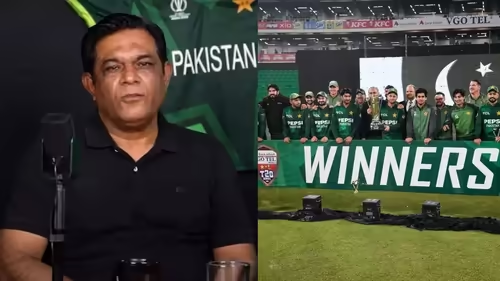
In the high-octane world of international cricket, few fixtures ignite passions like an India-Pakistan clash. But what if the biggest story isn’t the match itself, but the threat of its cancellation? Enter former Pakistan captain Rashid Latif, who has offered a stunningly pragmatic, almost Machiavellian, take on the ongoing controversy surrounding a potential Pakistan India boycott at the upcoming T20 World Cup.
Forget the usual narratives of political tension or security concerns. Latif, in a series of recent interviews, has pulled back the curtain to reveal a far more complex and calculated game being played out behind the scenes—one that targets the very heart of the International Cricket Council (ICC) [[5]].
Table of Contents
- Latif’s Shocking Revelation: It’s Not Personal, It’s Business
- The Bangladesh Connection: A United Front?
- How a Pakistan India Boycott Hurts the ICC
- The 24-Hour Window and What It Means
- Conclusion: A New Era of Cricket Power Plays?
- Sources
Latif’s Shocking Revelation: It’s Not Personal, It’s Business
For years, any discussion about a potential Pakistan India boycott has been framed through a lens of emotion and historical animosity. Latif, however, has shattered that narrative. He insists that such a move by the Pakistan Cricket Board (PCB) would be a cold, hard, and deliberate business strategy [[5]].
“This is not an emotional reaction,” Latif stated bluntly. His perspective is that the PCB is acutely aware of the immense financial and viewership power that the India-Pakistan rivalry commands. By threatening to withdraw from this single, most lucrative fixture, Pakistan holds a unique form of leverage over the ICC—a body whose revenue streams are heavily dependent on this marquee matchup [[4]].
This isn’t just about one match; it’s about using that match as a bargaining chip to influence broader decisions within the global cricketing body. The message is clear: if the ICC wants its golden goose to keep laying eggs, it must listen to its concerns.
The Bangladesh Connection: A United Front?
Latif’s analysis doesn’t exist in a vacuum. He directly links Pakistan’s potential stance to the ongoing crisis involving Bangladesh. The Bangladesh Cricket Board (BCB) has been locked in a bitter dispute with its own government, which has led to fears of their suspension by the ICC and subsequent removal from the T20 World Cup [[1]].
Latif has publicly urged the PCB to stand in solidarity with Bangladesh, suggesting a coordinated withdrawal from the tournament if their fellow Asian nation is excluded [[3]]. This proposed alliance transforms the situation from a bilateral issue into a multi-nation challenge to the ICC’s authority. It suggests a growing sentiment among some Full Member nations that they are willing to use collective action to push back against perceived overreach or unfair governance.
The idea is that if two major teams were to pull out, the credibility and commercial viability of the entire tournament would be severely damaged, forcing the ICC to the negotiating table.
How a Pakistan India Boycott Hurts the ICC
The financial implications of a Pakistan India boycott are staggering. Here’s a breakdown of why this single act is such a powerful weapon:
- TV Rights & Viewership Collapse: The India-Pakistan match consistently shatters global viewership records. Broadcasters pay a premium for these rights, and a cancellation would lead to massive refunds and a loss of future revenue confidence.
- Sponsorship Devaluation: Major global sponsors align their brands with the T20 World Cup largely because of the India-Pakistan spectacle. Its absence would significantly devalue their investment.
- Stadium Revenue Loss: Ticket sales for this match are astronomical. A boycott would leave a huge financial hole for the host nation and the ICC.
- Governance Crisis: It would expose the ICC’s inability to manage its most important members, raising serious questions about its leadership and future direction [[4]].
In essence, the boycott isn’t just a protest; it’s a direct attack on the ICC’s primary source of income and its global standing.
The 24-Hour Window and What It Means
Adding to the drama, Latif has famously declared that “in 24 hours, anything is possible” regarding the final decision [[5]]. This isn’t just a throwaway line; it’s a strategic piece of gamesmanship. By keeping the world guessing until the last possible moment, the PCB maintains maximum pressure on the ICC.
Every hour that passes without a confirmation of participation keeps the ICC in a state of anxiety, potentially forcing them to make concessions on other fronts—be it related to Bangladesh, future tournament hosting rights, or revenue-sharing models. This high-wire act is a classic negotiation tactic, designed to extract the best possible outcome by leveraging uncertainty.
Conclusion: A New Era of Cricket Power Plays?
Rashid Latif’s insights have reframed the entire conversation around the Pakistan India boycott. What was once seen as a simple political standoff is now revealed as a sophisticated, high-stakes gambit aimed at the core of international cricket’s power structure. By linking their fate to Bangladesh’s and threatening the ICC’s financial lifeline, Pakistan is attempting to shift the balance of power. Whether this bold strategy succeeds or backfires spectacularly remains to be seen, but one thing is certain: the days of passive acceptance of ICC decisions may be coming to an end. The era of assertive, financially-driven power plays in cricket has well and truly begun.